
Primary Home Defense Firearm Platforms: Performance & Evaluation Guide
Evaluating firearms for home defense requires balancing maneuverability, capacity, terminal effectiveness, and over-penetration risks. Below is a structured technical assessment of the primary defensive platforms.
Platform Analysis
1. Striker-Fired 9mm Handguns
-
Primary Role: Compact staging and close-quarters maneuverability.
-
Core Strengths: Small footprint allows rapid access from quick-opening lockboxes or bed-side staging. Enables single-handed operation if needed (e.g., opening doors, using a flashlight, or holding a phone). Typical capacity ranges from 15 to 17+ rounds.
-
Operational Drawbacks: A pistol provides only two points of contact, making fine motor control under high stress more difficult. Accuracy requires consistent training compared to shoulder-fired platforms.
-
Common Industry Benchmarks: Glock 19 / Gen 6, SIG Sauer P320, Smith & Wesson M&P9 M2.0, Walther PDP.
2. Pistol Caliber Carbines (PCC) & Short-Barrel AR-15s
-
Primary Role: Maximum stability, high accuracy, and fast target re-acquisition.
-
Core Strengths: Three points of contact (shoulder, dominant hand, support hand) provide exceptional stability. Low recoil profile allows rapid, accurate follow-up shots. Standard magazine capacity ranges from 20 to 30 rounds. Modern fragmenting 5.56 NATO loads can reduce drywall penetration risk compared to heavy handgun projectiles.
-
Operational Drawbacks: Larger physical profile makes navigating tight hallways more restrictive. High muzzle blast and noise levels in enclosed indoor spaces (specifically 5.56 NATO).
-
Common Industry Benchmarks: Ruger PC Carbine, CZ Scorpion, PSA AR-9, Standard 5.56 AR-15 / Bullpup platforms.
3. Defensive Shotguns (12-Gauge / 20-Gauge)
-
Primary Role: High close-range energy transfer per trigger pull.
-
Core Strengths: High immediate stopping power at room distances.
-
Operational Drawbacks: Significant felt recoil slows down follow-up shots. Limited shell capacity (typically 5 to 8 rounds). Pump-action designs introduce the risk of user-induced cycling jams ("short-stroking") during high-stress encounters. Heavy buckshot (#00 Buck) poses high wall-penetration risks in residential structures.
-
Common Industry Benchmarks: Mossberg 590 / 990 SPX, Remington 870, Beretta A300 Ultima Patrol.
Performance Comparison Matrix
| Platform | Handling & Stability | Indoor Mobility | Recoil Profile | Capacity Range | Wall Penetration Risk |
| 9mm Handgun | Moderate (2 Contact Points) | Highest | Moderate | 15–17+ rounds | Moderate (JHP loads) |
| 9mm PCC | High (3 Contact Points) | High | Low | 20–30 rounds | Moderate (JHP loads) |
| 5.56 AR-15 | High (3 Contact Points) | Moderate | Low–Moderate | 30 rounds | Low–Moderate (Fragmenting ammo) |
| 12GA Shotgun | Moderate (Recoil Heavy) | Low–Moderate | High | 5–8 shells | High (#00 Buckshot) |
Essential Defensive Upgrades
-
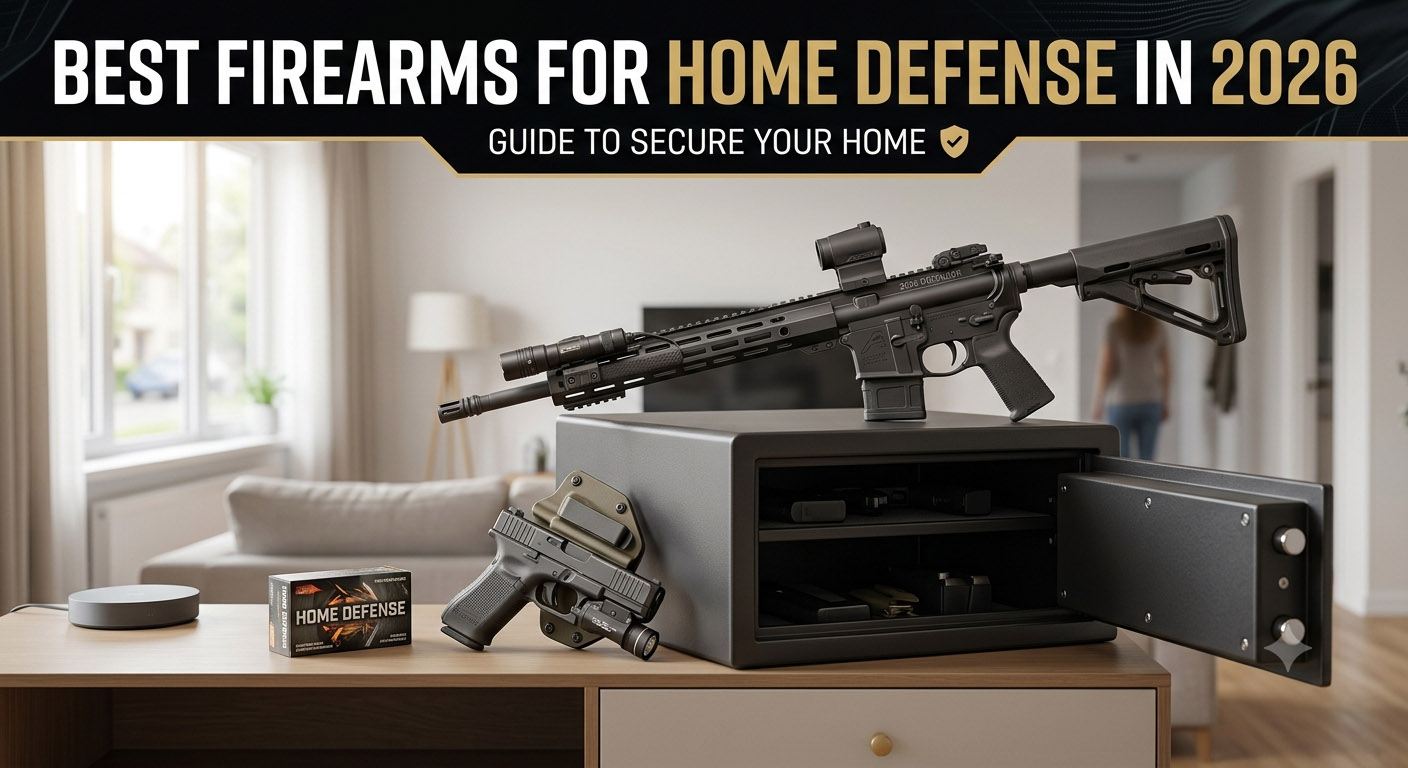
Weapon-Mounted Light (WML): Required for Positive Target Identification (PID) in low-light conditions.
-
Tested Defensive Ammunition: Premium Jacketed Hollow Points (JHP) for handguns/PCCs or managed-recoil #4/#00 Buckshot for shotguns to minimize over-penetration.
-
Rapid-Access Storage: Mechanical, biometric, or RFID safes to maintain immediate readiness while preventing unauthorized access.